
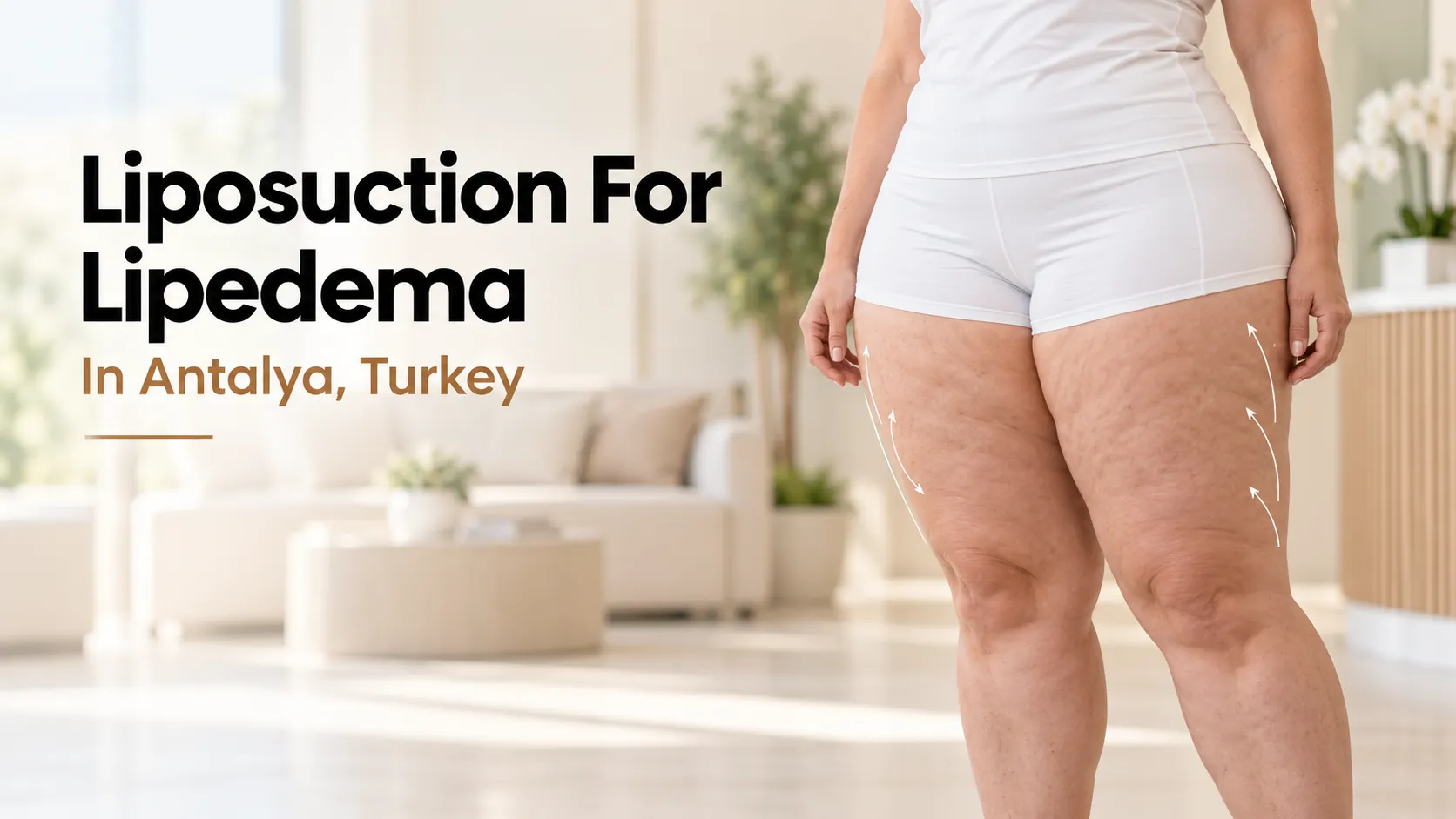
Your waist shrinks when you diet. Your legs don’t. Sound familiar? That stubborn, often tender fat on the hips, thighs and legs may be lipedema (lipoedema) — a fat disorder, not a lack of willpower. Liposuction for lipedema in Antalya, Turkey won’t cure the condition, but it can ease the pain and heaviness and bring your proportions back into balance. Below, you’ll find what lipedema actually is, where VASER liposuction fits in and how lipedema treatment in Turkey unfolds from start to finish.
What is lipedema?
Lipedema is a long-term condition in which fat builds up in an unusual pattern — usually on both legs equally, from the hips right down to the ankles. It affects women almost exclusively. And it tends to appear, or get worse, around times of hormonal change: puberty, pregnancy, menopause.
It often runs in families.
The fat itself feels different, too. Women living with it often say their legs feel heavy, sore or sensitive when pressed. Knocks you’d barely notice turn into purple marks, and still the feet look just as they always have. The result is a tell-tale “cuff” at the ankle, where the leg suddenly narrows. Lipedema doesn’t always stop at the legs; the upper arms may show it too.
Lipedema or just stubborn fat?
Fair question — at first glance they can look alike. A few clues set them apart:
| Sign | Lipedema | Ordinary excess fat |
| Where it sits | Hips, thighs, calves, occasionally the upper arms — matched left and right, with hands and feet left out | Shared out over the whole body, belly included |
| Response to diet | Waist and upper body slim down; legs barely change | The whole body slims gradually |
| How it feels | Often tender, heavy or painful | Usually painless |
| Bruising | Bruises easily | No particular tendency |
| Who it affects | Almost always women | Anyone |
Only a proper examination can tell for sure. Plenty of women — in the UK, across Europe and here in Turkey — spend years being told to “just eat less” before anyone puts a name to the problem.
Will dieting reduce lipedema?
Not the lipedema fat itself. No.
On a diet, the cheeks, middle and upper body respond first; below the hips, lipedema fat hardly moves. The US standard of care for lipedema, drawn up by a panel of specialists in 2021, describes this same pattern: lipedema tissue resists calorie cutting in a way ordinary fat doesn’t.
So why bother with healthy eating at all? Because every extra kilo sitting on top of lipedema loads the hips and knees further, and the aching usually gets worse with it. Healthy food choices and a steady weight can’t make lipedema vanish. What they can do is keep it from building up, which is why they belong in the plan before lipedema surgery and long after it.
What happens if lipedema is not surgically treated?
For some women, very little changes for years. For others, it slowly gets worse.
Left alone, lipedema can progress: the fat becomes lumpier, the legs heavier and the pain more frequent. Walking any distance becomes tiring, the knees carry more than they should and, further down the line, the skin can sag into folds; fluid may also start to pool when the lymph system can no longer cope. Then there’s the emotional side (clothes that never fit, legs you’d rather keep covered), which is rarely talked about but very real.
Not everyone needs an operation. Compression, regular movement and a healthy weight help many people manage well; surgery comes into the picture when symptoms keep getting in the way of daily life despite that care.
How does VASER liposuction help with lipedema?
VASER brings ultrasound into the liposuction process. A slim probe sends gentle vibrations into the fat layer, loosening the fat into a softer, almost liquid state; fine cannulas then suction it out. Lipedema fat is denser and more fibrous than ordinary fat — which is exactly why that loosening step helps, and why VASER liposuction for lipedema is the technique of choice at the clinic in Antalya.
Wondering how VASER compares with other approaches? The article on 360 liposuction vs VASER liposuction puts the two methods next to each other.
Why a gentle, lymph-sparing approach matters
Your lymphatic vessels — tiny channels that drain fluid from the tissues — run right through the fat on your legs. Rough handling can damage them. Injure those vessels, and swelling gets worse instead of better.
So the technique is careful by design. The fat is softened first; the cannulas move along the length of the limb, following the natural direction of the vessels rather than cutting across them; and the work is steady, never aggressive. That’s what makes it lymph-sparing liposuction. Gentler on the tissue; easier to recover from.
Is liposuction a cure?
No. And any clinic promising one deserves a raised eyebrow.
Lipedema liposuction removes diseased fat and, for most patients, eases the pain, heaviness and easy bruising that made everyday life hard. A German study (Dadras et al., 2017) followed 25 patients for around three years after lipedema liposuction: pain, tenderness and bruising dropped, quality of life improved and their need for conservative therapy, such as compression, went down. Lipedema itself stays, though. Think of surgery as a way to relieve symptoms, with nutrition, weight control and follow-up care staying in the picture for good.
How many sessions will you need?
It depends on you: how much tissue is affected, which areas are involved (thighs, knees, calves, arms) and your general health.
There is a firm limit on how much fat can safely come out in a single operation. Pushing past that limit in one sitting makes fluid loss, bleeding and slow healing more likely, which is why the plan is built around what your body tolerates safely — never around squeezing everything into one day. For some women one session is enough; others need two or more, spaced a few months apart so the body can recover in between. Travelling to Turkey from abroad? The timing between sessions is planned with your trips to Antalya in mind.
Your plan is set after the examination. Not before.
Who is a good candidate?
You may be a good fit for lipedema surgery in Turkey if:
- you have a lipedema diagnosis, or symptoms that clearly point to it and need assessing;
- the aching, the heavy legs or the bruising still get in your way, despite giving compression and other conservative measures a fair try;
- your weight hasn’t swung up or down much lately;
- you are in good general health for anaesthesia;
- you’re ready to commit to aftercare — compression, follow-ups, healthy eating;
- you expect relief and better proportions, not a brand-new body overnight.
What should I expect from liposuction for lipedema in Turkey?
Put simply: careful checks first, a well-planned procedure next and regular reviews for as long as you’re in Antalya.
Surgery day and your stay
The operation takes place in hospital, under anaesthesia planned by the anaesthetist; how long it lasts depends on the number of areas treated. When you come round, you’ll already be in a compression garment, feeling tender and a bit puffy (nothing unusual there). The team will have you up on your feet once it’s safe — walking keeps the blood flowing. You’ll be seen for check-ups throughout your time in Antalya, and the team will tell you when it’s fine to travel home.
After lipedema surgery
The weeks after surgery decide how well the result holds. Not glamorous — but it matters.
Compression garments and lymphatic drainage (MLD)
Expect to wear a compression garment for several weeks; it keeps swelling under control and helps the tissues settle into their new shape. Your surgeon may also recommend manual lymphatic drainage (MLD), a gentle massage technique carried out by a trained therapist to help excess fluid move along. Some patients need it, some don’t, and the start date differs — stick to the schedule set for you.
Recovery, week by week
- First few days: sore, swollen, bruised — all normal at this point; a few slow laps of your room or hotel are plenty.
- Weeks 1–2: most people feel up to light daily tasks or desk work.
- Weeks 3–6: swelling drops steadily, and gentle exercise comes back bit by bit.
- Months 3–6: the legs feel noticeably lighter; leftover swelling keeps fading.
- Up to a year: the final shape settles.
Everyone heals at their own pace. For more detail, see the liposuction healing timeline.
Keeping the results: nutrition and weight control
What happens next rests largely with you. The fat cells that were removed won’t come back; the ones left behind can still grow. Plenty of vegetables, enough protein, mostly unprocessed food, a stable weight and joint-friendly activity such as walking, swimming or cycling will help you hold on to the result.
And the effort pays off. A German follow-up study (Baumgartner et al., 2016) found that the improvement in pain, swelling and bruising was still there an average of eight years after surgery.
Frequently asked questions
No. It removes the diseased fat and usually eases pain, heaviness and bruising — but the tendency behind lipedema stays, so healthy eating and weight control remain part of life afterwards.
Fat cells removed during liposuction don’t regenerate. Those that remain are a different story: they can still swell, usually with weight gain or hormonal shifts, so aftercare and a steady weight make a real difference.
Yes. VASER works on lipedema in the upper arms as well, and arm treatment is usually given its own session rather than being combined with the legs.
Not much on the scales. The goal is easing pain and improving body balance rather than shedding kilos.
Thinking about your next step?
If your legs have ached for years and nothing seems to help, an honest assessment is a good place to start. To book a consultation in Antalya, Turkey, use the contact page and the team will arrange a time with Op. Dr. Bülent Demir.

Op. Dr. Bülent Demir
PLASTIC AND AESTHETIC SURGEON · ANTALYA
Op. Dr. Bülent Demir is a member of the Turkish Society of Plastic, Reconstructive and Aesthetic Surgeons and has worked in aesthetic and reconstructive surgery for many years. His main areas of interest are breast surgery, mummy makeovers, liposuction and lipedema treatment. At his clinic in Antalya, he treats patients from across Turkey and abroad.
This article is for general information only. Diagnosing and treating lipedema requires a consultation.
Sources: Herbst KL et al. Standard of care for lipedema in the United States. Phlebology. 2021;36(10):779–796. · Dadras M et al. Liposuction in the treatment of lipedema: a longitudinal study. Arch Plast Surg. 2017;44(4):324–331. · Baumgartner A, Hueppe M, Schmeller W. Long-term benefit of liposuction in patients with lipoedema: a follow-up study after an average of 4 and 8 years. Br J Dermatol. 2016;174(5):1061–1067.