
Deciding to have breast augmentation surgery is actually the easy part. The real dilemma comes later: which implant type?
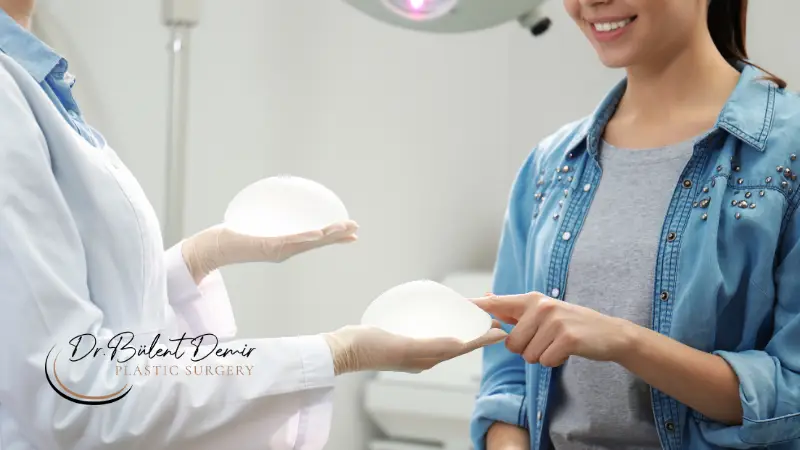
As a patient, you’ll be faced with a wide range of options. Round or teardrop-shaped, how many cc, which profile, gel or saline… Most people come to the consultation saying, "I want a natural yet full look," but they don’t realise that there are dozens of technical decisions behind this. It is precisely these decisions that directly determine the result you’ll see when you look in the mirror after the operation.
In this article, I will go through the seven key points you should bear in mind when choosing breast implants, one by one. My aim is to ensure that when you come for your consultation, you are able to ask the right questions and make an informed decision.
1. The shape of the implant: Round or teardrop-shaped?
The first and most obvious decision is the shape of the implant. Silicone implants are essentially manufactured in two shapes.
Round silicone implants, as the name suggests, have a symmetrical, round shape. They also add fullness to the upper part of the breast. Patients who want a fuller, more defined cleavage generally prefer this shape. They look balanced from every angle when you move.
Teardrop-shaped (anatomical) silicone implants, on the other hand, mimic the natural shape of the breast. They are less full at the top and fuller at the bottom – much like a teardrop that widens towards the bottom. They provide a much more natural appearance, particularly offering a significant advantage for patients who are slender or have little or no breast tissue.
It is not possible to give a definitive answer as to which is better. It depends entirely on the look you are after and your body shape. If you want a fuller, more pronounced look, round implants are generally more suitable; if you prefer a natural, balanced look, teardrop-shaped implants are usually the better choice.
2. Implant size: How many CC should it be?
It could be said that the issue patients are most concerned about—and most often misunderstand—is implant volume.
Silicone size is not measured by bra cup size (such as B, C, D), but in cc (cubic centimetres). Simply saying ‘I want a C cup’ is not enough, as the same cc size will correspond to different cup sizes on different bodies.
When determining the correct size, you need to consider the width of your ribcage, your shoulder structure, your existing breast tissue and the elasticity of your skin. Inserting silicone implants that are too large into a narrow ribcage will not look natural and may cause problems for the skin and tissue over time.
The biggest mistake here is the notion that "the bigger, the better." Silicone implants that are disproportionately large for your body can result in back pain, sagging skin and an unnatural appearance. A good result is one that is in harmony with your body. The decision is made during the consultation, based on measurements and, if necessary, by trying on a trial bra.
3. Profile: The degree of projection of the silicone implant
This is a detail that most patients are not even aware of, but which has a significant impact on the outcome. The profile refers to how far the silicone implant protrudes from the chest wall.
Two silicone implants of the same cc volume will look completely different if their profiles differ. Think of it this way: you can make a 300 cc silicone implant wide and flat, or you can make it narrow at the base but more prominent at the front. Both are 300 cc, but they look very different.
Generally speaking, there are three profiles: low profile, medium profile and high profile. Whilst a high profile is more suitable for patients with a narrow ribcage, a low or medium profile looks more natural on a wider chest. The choice of profile cannot be considered in isolation from the choice of size; the two are assessed together.
4. Internal filling: Silicone gel or saline solution?
Implants can be filled with different materials. Today, two main types are predominantly used.
Silicone gel-filled implants are the most popular type today. They offer the softest texture and the most natural feel, most similar to natural tissue. In particular, the so-called ‘form-stable’ models—which have a gel-like consistency and remain in place (commonly known as ‘gummy bear’ silicone)—retain their contents even if they tear. This offers a significant safety advantage.
Serum (saline)-filled implants, on the other hand, are models filled with sterile saline solution. They are used less frequently because they do not feel as natural as silicone gel and are more likely to develop rippling. Nevertheless, they may be preferred in certain circumstances.
For most patients, form-stable implants filled with silicone gel are the preferred choice in terms of both natural appearance and safety.
5. Surface texture: Textured or smooth?
The outer surface of the prosthesis is also one of the selection criteria. There are two options: textured and smooth surfaces.
Implants with a textured surface adhere better to the tissue, stay in place and, particularly in the case of silicone implants, reduce the risk of rotation. the risk of rotation, whereas implants with a smooth surface, on the other hand, move more freely.
The key point here is the link between the choice of surface and a complication known as capsular contracture. The body forms a thin membrane around any foreign object; sometimes this membrane can harden and constrict the implant. The type of surface is one of the factors that influence this risk. Which surface is suitable for you depends on your breast tissue density and the shape of the implant chosen.
6. Placement: Under the muscle or over the muscle?
The decision on where to place the silicone implant is also a key factor affecting the outcome. The implant is placed either under the chest muscle or over the muscle (under the breast tissue).
Submuscular placement generally provides a more natural transition and is advantageous for mammograms, but the recovery process may require a slightly longer downtime. Subglandular placement, on the other hand, offers a more comfortable early recovery, but the edges of the implant may be visible in patients who do not have sufficient breast tissue.
This is a detailed decision-making process in its own right. Which implant placement is right for you depends on the amount of breast tissue you have and your skin type. If you’d like to explore this topic in more depth, we’ve covered it in detail in our article "Breast augmentation over the muscle vs. under the muscle".
7. Brand, warranty and safety
This final point is perhaps the most important. Because even if you choose the right shape, size and profile, the quality of the prosthesis used takes precedence over everything else.
A reliable breast implant must be FDA and CE approved. Products from well-known brands that have been in use worldwide for many years should be preferred. These brands generally offer a lifetime guarantee and a replacement guarantee under certain conditions. It is standard practice for a reputable clinic to provide you with an identification card containing the brand and serial number of the implant to be inserted before the operation.
Another issue that comes to mind when discussing safety is BIA-ALCL. This is an extremely rare condition associated with certain types of textured surfaces. Your doctor will take these risks into account when selecting a prosthesis. In other words, the choice of brand and safety is a decision that directly affects your health.
Breast augmentation in Antalya
Choosing breast implants is not a single decision; it is the sum of seven interrelated decisions: shape, size, profile, filling material, surface texture, placement and brand. When all these factors come together, they produce the result you desire.
The right decision becomes clear during the consultation. Advice given without taking measurements or assessing your body type is often misleading. You can book an appointment at Dr Bülent Demir clinic in Antalya for breast augmentation surgery and prosthesis selection.
F.A.Q.
It is not possible to give a definitive answer; it depends entirely on the look you are aiming for and your body shape. Round silicone implants are generally more suitable for those who want a full and prominent cleavage, whilst teardrop-shaped (anatomical) silicone implants are generally more suitable for those who want a natural and balanced look.
Silicone implant size is measured in cc, not by bra size, and the same cc size will look different on different bodies. The correct size is determined by considering the width of the ribcage, shoulder structure, existing breast tissue and skin elasticity. The decision is made during the consultation, based on measurements taken and, if necessary, by trying on a trial bra.
Silicone gel-filled implants are the most popular choice today; they offer the softest texture and the most natural feel, most similar to natural tissue. Form-stable ("gummy bear") models retain their contents even if they tear. Saline-filled implants, on the other hand, are used less frequently; they do not feel as natural as silicone gel implants and are more likely to cause rippling.
This article is intended to provide general information. Please consult your surgeon for further details.
If you are planning to have breast augmentation surgery in Antalya, Turkey, you can place your trust in Dr Bülent Demir, who has over 20 years’ experience. Click here for breast augmentation before and after. Schedule a consultation to find out which breast augmentation technique is most suitable for you.